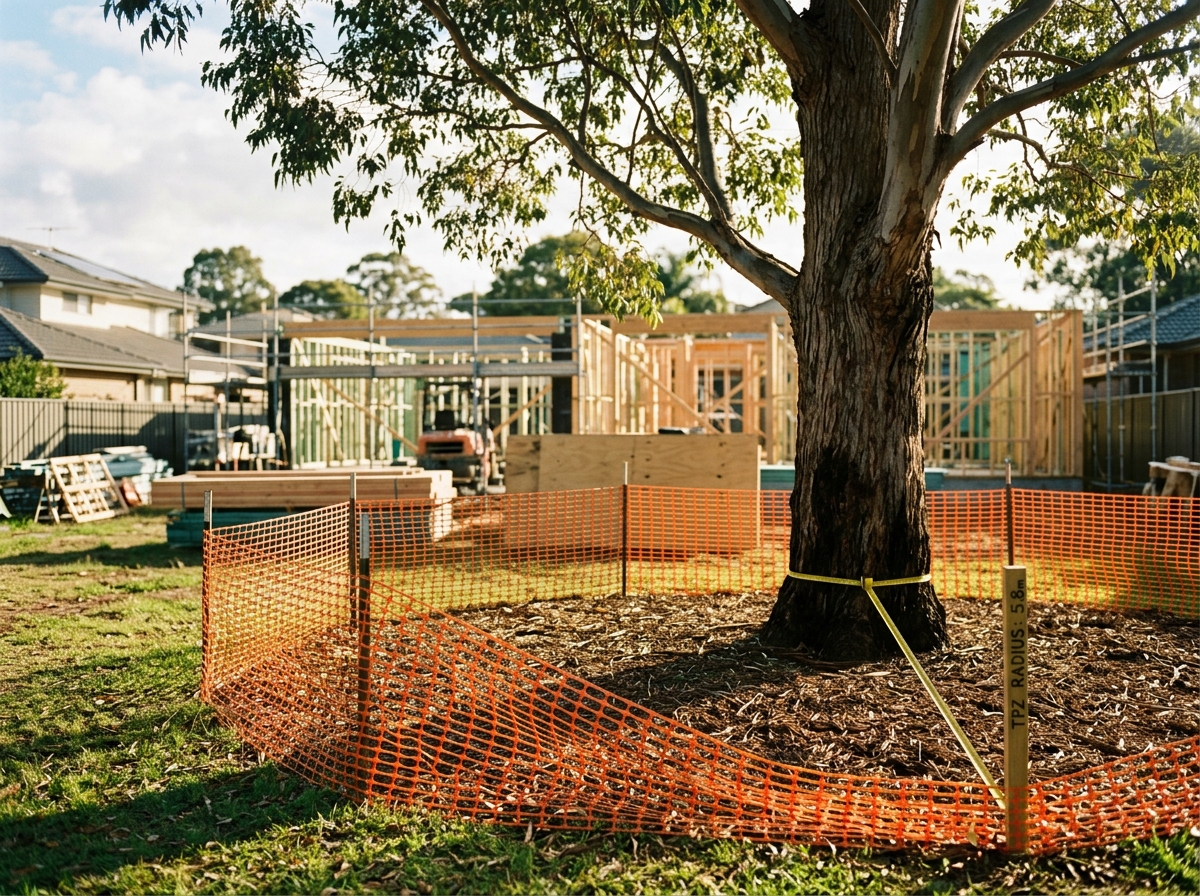
Eucalyptus tree ringed by orange mesh fencing at a building site, with a measuring tape to the fence and timber framing behind
star
Rated 4.8/5 from 182+ verified Google reviews

Tree Protection Zone Calculation for Building Works

Building near trees? Trees Down Under’s AQF-certified arborists calculate the tree protection zone so your works stay approved and your trees stay standing. Book a free tree inspection, get same-day quoting, or call 0475 463 597 any time.

What is a tree protection zone and why does it matter?

A tree protection zone (TPZ) is the area around a trunk that is set aside during building works so roots and soil stay undisturbed. Our AQF Level 3-5 certified arborists calculate the TPZ and the structural root zone (SRZ) for homeowners, builders, developers and certifiers, so the figures are ready before a development application (DA), demolition or excavation goes ahead.

The reason it matters is simple. Digging, machinery movements, soil compaction and stored materials inside the zone can damage the roots a tree relies on for water, nutrients and stability. A tree can look healthy for months, then decline or become unsafe. On a protected tree, that damage can also breach council conditions, and unauthorised work can bring penalties over $10,000 plus mandatory replanting.

What you receive is a site assessment, the TPZ and SRZ calculation, an arborist report and clear protection recommendations your builder can follow. An accurate figure keeps the approval moving and avoids redesigns mid-project. If a tree cannot realistically be retained, we will say so at the start. We can also help with tree removal, subject to council permit requirements.

Book a free tree inspection with same-day quoting, or call 0475 463 597 any time.

How a tree protection zone is worked out on your site

Measure the trunk, then apply AS 4970

The arborist measures diameter at breast height (DBH) at 1.4 m above ground. Under AS 4970 Protection of trees on development sites, the TPZ is calculated from that figure, with the SRZ worked out separately for stability. The result sets where your protection fence goes and how far machinery must stay back.

Test the zone against your plans

  1. Check tree height, canopy spread and trunk size against council protected tree criteria.
  2. Overlay the TPZ and SRZ on your building footprint and machinery paths.
  3. Where work enters the zone, assess whether the encroachment is acceptable or the design needs to shift.

A zone drawn on paper means nothing until the builder can see it on site. We mark it clearly so everyone knows where the digging stops.

Joseph Khoury, Director & Founder, Trees Down Under

Document it for council and your builder

The findings go into an arborist report with zones marked on your site plans, ready for your DA or certifier. Need it checked before work begins? Call 0475 463 597 any time to book a free tree inspection.

Eucalyptus trunk with a yellow measuring tape, ringed by orange mesh fencing; concrete slab and timber framing behind.

Which trees are protected and when do you need approval?

Before any building works start, the first question is whether the tree is protected. In the Hills District, a tree generally qualifies if it is over 3 m tall, has a trunk over 30 cm in diameter measured at 1.4 m above ground, or has a canopy spread over 5 m. Heritage significance or environmental value, such as a biodiversity corridor, can also bring a tree under protection. Trees in mapped vegetation or foreshore zones and many native species often need approval too, while dead or dangerous trees may be exempt.

Approval is needed before removing, pruning or damaging a protected tree on private property. That includes tree removal Sydney homeowners assume is routine, and damage from excavation or machinery inside the TPZ. Unauthorised work can bring penalties over $10,000 plus mandatory replanting at the owner’s expense.

Trees Down Under’s AQF Level 3 to 5 certified arborists offer a free tree inspection, check your site against council criteria and advise whether a permit is required before any work begins. To book, call any time on 0475 463 597.

Eucalyptus tree ringed by orange mesh fencing and wood-chip mulch, with a tape measure to the fence, on a cleared building site.

Start planning at least one growing season before construction

Early planning gives retained trees time to recover from nearby removals and lets root-zone protection go in before work begins. Calculation errors can also delay approvals, so book a free inspection before your plans are lodged. Call 0475 463 597 any time. Emergency attendance for storm-damaged trees on active sites is available 24/7.

When is removal the safer option?

Some trees cannot be saved by a better protection zone. A tree within roughly 3 m of a proposed structure rarely survives construction, and it can put workers and machinery at risk. Our AQF Level 3-5 certified arborists flag these trees at the initial site assessment, along with any tree unlikely to cope with protection measures.

On larger sites, we plan staged removals and coordinate with your other trades, so clearing happens before excavation, foundation work or deliveries begin. Before any tree removal, we check council permit requirements, because protected trees need approval first.

Not sure whether a tree can stay? Call 0475 463 597 any time to book a free tree inspection and ask about same-day quoting.

Mature eucalyptus marked with an orange X stands beside fresh concrete formwork, its cut roots exposed in raked soil.

What to have ready before you book a site assessment

A defensible TPZ and SRZ figure comes from good information, and the free tree inspection goes faster when you bring the following:

  • Site plans and the proposed building footprint, so the arborist can measure how close each tree sits to new walls, slabs and services.
  • Machinery access paths and storage areas, since excavators and material stacks are common causes of root damage inside a TPZ.
  • Any council overlay, vegetation mapping or bushfire constraint on the lot, including the 10/50 rule if it may apply.
  • Your planned timeline, including the DA lodgement date or demolition start, so staged tree removal can be planned around other trades.

With these in hand, the arborist can calculate the zones, flag which trees need a council permit and advise on approvals in one visit. Not sure what you have? Send what you can and the team will work from there. Call 0475 463 597 any time to request a free inspection and same-day quoting. The team can also advise if tree removal is the safer option for your site.