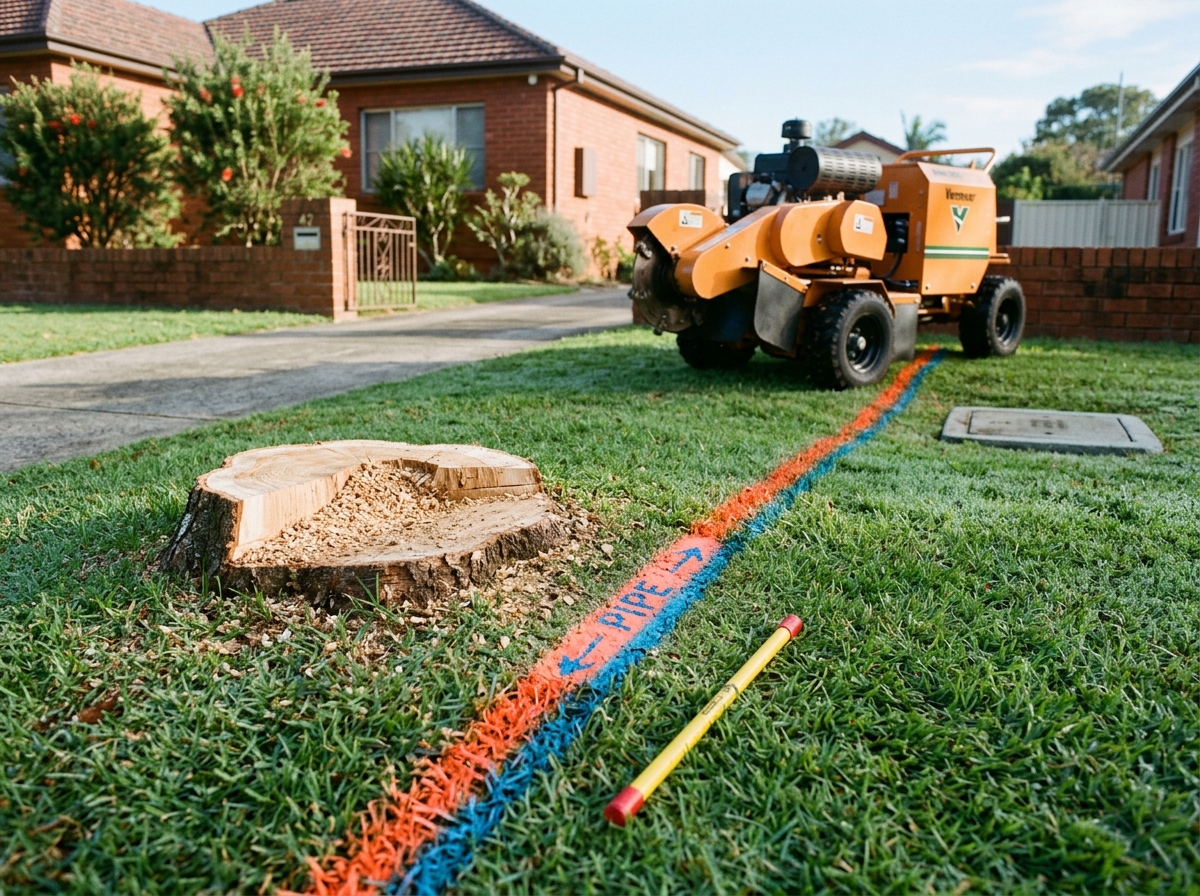
Partly ground tree stump on a dewy lawn beside orange and blue pipe markings, with a stump grinder parked nearby.

Stump Grinding Without Damaging Underground Pipes

Worried about hitting a sewer or stormwater line? Our AQF Level 3-5 certified arborists locate underground pipes first and set a controlled grind depth. Book a free tree inspection with same-day quoting, or call 0475 463 597 any time.

Why pipes are the main risk in stump grinding

Stump grinding is more localised than full stump excavation, so it disturbs less soil and is generally lower risk near buildings. The real concern sits underground. In established Hills District and Sydney suburbs, services have often been added over time, so shallow stormwater lines, irrigation, shed conduits and older pipes can sit close to the surface, right where a tree’s roots tend to spread. Roots can wrap around or lie over sewer, stormwater, water and gas lines, and a grinder cutting too deep or working blind can crack or shift them.

That is why Trees Down Under inspects first. A free tree inspection lets our AQF Level 3-5 certified arborists look at the stump, the surrounding yard and the likely service runs before any grinding is planned. We also give same-day quotes where possible. If the stump belongs to a tree that still needs to come down, we can handle the tree removal and the stump together, and we will flag any council permit requirements before work is scheduled.

Worried about a stump near a pipe? Call 0475 463 597 any time to book an inspection.

How a careful contractor protects your pipes and cables

Inspect, then locate

Every job starts with a free tree inspection and a walk of the yard. The team checks the stump, the soil and where sewer and stormwater lines, irrigation and shed conduits are likely to run. Services are then located through Dial Before You Dig and verified on site, and any lines you already know about get marked.

Grind to a set depth

Grinding depth is agreed before the machine starts, and technique is matched to the stump and soil. Near a pipe, our AQF Level 3-5 certified arborists limit how far they chase roots rather than cutting blindly toward a line.

Finding the pipes first is half the job. If the yard is crowded with lines, we change the plan, not the pipe.

Joseph Khoury, Director & Founder, Trees Down Under

Clean up and level

Once grinding is done, the site is cleaned and levelled. If the stump is part of a wider tree removal, ask about council permit checks too. To book an inspection or get a same-day quote, call 0475 463 597 any time.

Freshly cut tree stump on a backyard lawn with orange and blue spray-paint markings, an arrow and a yellow flag stake beside it.

What happens to the roots after grinding?

Stump grinding removes the stump to a set depth below ground. It does not pull out the whole root system the way excavation does, so many roots stay in the soil and break down over time. That is usually a good thing near pipes, because it means less digging and less disturbance around sewer and stormwater lines.

The catch is that roots may already be affecting your pipes or paving before the stump comes out. Chasing them blindly toward a slab or a buried line can do more harm than leaving them alone. Our AQF Level 3-5 certified arborists look at what the roots are actually doing and advise whether monitoring, root management or a repair is the smarter option. Where services are tight, we may limit the grinding depth or hold back on following roots altogether.

If the stump is part of a larger tree removal job, we also check council permit requirements before any work starts. For a free tree inspection and same-day quotes across the Hills District and wider Sydney, call 0475 463 597 any time.

Fresh tree stump on a dewy lawn with orange and yellow utility markings, flag stakes and a red spray paint can.

Know where your pipes run? Tell us before we start

Mark or point out any pipes and cables you know about, and the arborist will check them against the on-site service location. Book a free tree inspection, or call 0475 463 597 for a same-day quote.

When grinding close to a structure is not a good idea

Grinding is more localised than excavation, so it is usually the safer choice near buildings. But close to a structure, it is not always the sensible one. Trees Down Under inspects the site first and will say so plainly when a job needs a different plan.

Warning signs include cracked masonry, shallow footings, loaded retaining walls and ground that is already moving. Foundation damage is unlikely when a grinder is used correctly, but the risk rises when grinding right against a footing, on unstable soil, or where vibration-sensitive problems already exist. Unknown drainage runs, or sewer and stormwater lines crowded into a small yard, are another red flag. In those cases we may limit the grind depth, restrict root chasing, or recommend a different removal and remediation approach.

Council rules can also apply when grinding is part of a tree removal, and requirements vary across Sydney, particularly in heritage areas or where tree protection controls apply. Permits should be confirmed before any tree is taken out, and Trees Down Under can help with that. Worried about a stump near your home? Call 0475 463 597 any time to arrange a free tree inspection.

What should you ask before you book?

A good stump grinding contractor can answer these questions plainly. Trees Down Under works through them on every job, starting with a free tree inspection.

  • How will you locate underground services? Expect Dial Before You Dig plus on-site verification of sewer and stormwater lines.
  • What grind depth will you use? It should be set for the site, not left to chance.
  • How do you handle roots near pipes, slabs or retaining walls? Chasing them blindly is a risk.
  • Will I get post-job notes? Ask for advice on backfill, settlement and drainage.

If grinding is part of a tree removal, confirm council permit requirements first. Call 0475 463 597 any time to book an inspection.

Fresh tree stump on a backyard lawn beside orange paint marks, a yellow probe and exposed grey PVC pipe in the soil.