
Author: editor
What is the Difference Between Tree Lopping & Tree Pruning?
Trees grow and will eventually need trimming. You can remove branches from a tree using two distinct techniques, lopping and pruning.
These two techniques often get mixed up as they somehow involve similar methods. However, they produce vastly different results.
For someone who has little understanding of arboriculture, it might not be easy to distinguish the techniques. This article will help you differentiate tree lopping and pruning so you can make the right decisions when trimming trees.
Tree Lopping
Lopping is a preventive approach of careful branch cutting for directional growth. It helps you save a tree as you only remove branches instead of eliminating the entire tree.
Its main focus is to cut off damaged or rotten parts of a tree that no longer show signs of growth while encouraging longevity.
Basically, lopping is the trimming of branches to reduce the tree size. Some trees can grow larger, giving you a headache, especially those standing a few meters away from your property. Chances are, you will be dealing with trees interfering with your walls or roof.
Besides, their branches may endanger the people around the area as they can fall unexpectedly at any minute. Trees with damaged sections need lopping to restore their health and extend their lifespan.
For a tree lopping service, you will need the help of professionals. It’s essential to know who to call if you ever have trees on your property to take care of.
The experts can help you cut down half of your tree at a safe height and perform tree lopping using the right tools and equipment.
Tree Pruning
Pruning focuses on cutting away small tree branches partly when necessary. It is a beneficial process for trees, especially when it comes to the perspective of health.
You can prune a tree using different techniques, such as crown lifting, thinning, cleaning, and reduction.
Since trees will have new shoots that will later turn into branches, removing them earlier will help keep your trees in shape.
Old branches will keep growing, and the developing shoots can go out of boundaries when they start to get big. New branches can occupy significant space for other plants. Hence, you will need to have them pruned as early as possible.
Besides, trees are vulnerable to diseases and other infestations. Fortunately, pruning can prevent the spread of such diseases. If the problem has started from the branches or leaves, your trusted arborist can spot them and cut those parts for you.
If you have certain tree types that bear fruit or flower, then you must practice annual pruning. This is because new branches will guarantee the growth of high-quality flowers and fruit.
Final Thoughts
Trees play an important role in our surroundings, and they need proper care for our safety. If you have trees that’s near structures or buildings, lopping and pruning them would be necessary.
Lopping allows you to remove damaged portions of trees to reduce tree size, while pruning helps improve trees’ health and shape.
Both lopping and pruning can save a tree. However, if these two processes fail to do so, complete tree removal would be your last resort.
If you need help with tree care and removal, you can always contact us at Trees Down Under. We are within your reach anytime.
Types of Fallen Tree Damage & What You Should Do
Fallen trees often result from severe weather or strong winds. But whatever the cause is, dropped trees or branches bring a great deal of damage and inconvenience.
This unfortunate situation can affect properties and people significantly. To understand more, we’ve listed the common types of fallen tree damage and what you should do to prevent them.
Damage to Property, Building or Structure
A fallen tree can cause destructive damage to buildings and structures. There are various reasons why trees fall. Some may be unavoidable, while others are preventable.
Trees falling due to heavy winds or storms are out of your hands. However, fallen trees caused by pests and human error are often manageable.
Keep your trees in good condition and avoid sudden falling issues by taking preventive measures. Another best way to avert the damages from fallen trees and branches is to refer your concern to an expert arborist.
The professionals will inspect every part of your tree, including the ground where it’s standing. They can classify trees with a high risk of falling and perform tree removal to prevent building or structure damages.
Feel free to ask for recommendations as some trees may not need complete removal. Dead or damaged trees are often the ones you need to take care of, especially when they’re standing near houses or other structures.
Automobile Damage
When a tree suddenly falls on your car or other types of vehicle, it may cause significant damage and leave you frustrated.
Any automobile parked outside, especially those that are near trees, are susceptible to damages. Fortunately, you can turn to a licensed arborist to identify which trees bring great hazards to vehicle parking areas.
During a storm or severe weather condition, it is advisable to park your vehicle indoors to avoid damages from a fallen tree. Although it is not always possible, it’s one of the best ways to make yourself at ease during such times.
Road & Trail Closure
Fallen trees and slump branches are among the most common causes of blocked roads and trails. This situation often happens after a heavy storm, making emergency responses quite difficult.
Moreover, fallen trees bring a series of inconveniences. Not only does it restrict access to emergency response personnel, but also it blocks cars and other vehicles from passing the way.
It’s best to remove or trim trees that impose threats of road and trail blockage. Tree removal will help you ensure safety and accessibility at all times.
Power Interruption
Power lines can also incur damages due to fallen trees. When a tree or branch falls on electrical cables during a storm, it can disrupt the power connection.
The loss of electricity supply can significantly affect homes and businesses. In worst cases, it may lead to food spoilage, data loss, and other problems.
Removing trees that may damage electrical connections is necessary to prevent outages. Ask a qualified arborist in Sydney to do the job for you safely.
Injury & Death
Although not common, injuries and death can also result from fallen trees or branches. Most unfortunate incidents occur when people are inside their homes, and a tree suddenly drops on them.
There are also instances of injuries and deaths outdoors, usually during severe weather. It is essential to ensure you’re in a safe place when a strong wind or storm strikes.
Prevent Fallen Tree Damage with Tree Care and Removal
Trees need care and maintenance to remain sturdy and healthy. The best way to avoid fallen tree damages is to apply preventive measures.
Regular inspection will help you know the condition of your trees, especially those that are only a couple of metres away from your house or building. Ask an expert arborist to do this for you as they know the proper techniques for tree care.
If there’s a need to remove a tree for your safety, your arborist will tell you and do the removal job as well. When you see a fallen tree, whether it has caused damages or not, take action right away and remove it from the site.
Your best option for tree care and removal is to call a trusted arborist in Sydney. What you need is Trees Down Under to come and perform an exceptional tree removal service for you.
We are always up and coming for any tree services. If you want to keep your property and trees safe, we can do careful inspections and preventive measures to prevent fallen tree damages.
Tree care and removal is our specialty. Call us for professional assistance on tree-related issues.
Will Tree Roots Damage My House
We all admire the sight of a majestic tree. But, did you know that trees’ roots can grow through rock? Yes, you read that correctly!
A tree will eventually grow through rock and even our homes rather than around it. Trees with strong and invasive root systems are tenacious. That’s why when trees grow close to our homes, it is often a source of concern for all homeowners. Regardless of its benefits, if the rooting system outweighs the detrimental effects, a tree should be cut down to prevent structural damage.
However, understanding the factors contributing to the damages allow us to determine better what action to take. Also, if the situation necessitates seeking professional assistance, by all means, do so. It is more desirable to be safe than to be sorry later. Know about the risks, as well as what we can do to avoid problems in the future.
Different Types of Trees with Invasive Rooting System
The size of tree roots ranges from narrow to wide and shallow to deep. The tree’s dimensions are designed to provide stability and water uptake. That’s why roots can pose a serious risk to every property owner when they become invasive.
Therefore, before planting a tree in your backyard or anywhere else on your property, know which trees have a deep root system. This is not an extensive list; however, the following are some of the most popular trees with profound taproots:
- Black gum
- Sassafras
- White oak
- Walnut tree
- Hickories
- Butternut
- Pines
- Sweetgum
- Japanese Pagoda
- Hornbeam
Why Do We Have to be Concerned About Invasive Roots?
Trees are an excellent addition to any garden. Simply because they provide numerous health, environmental, aesthetic, and even economic benefits, some species, however, should be avoided due to their potential to cause structural damage to a property and its surroundings.
Here are some of the issues a tree with invasive roots can cause:
- Invasive roots can create an irregular structure that will likely display a safety hazard that could result in trips or falls.
- Roots can infiltrate your property’s drainage such as septic lines. This can result in clogging the sewerage that will pose a significant health risk to its surroundings including soil, water and air.
- Roots can cause warping or sinking of the pavement or pathway
- Invasive roots can shift your retaining walls
This will not only cause structural damage to your home but may also necessitate costly tree removal.
What are the Warning Signs of Invasive Rooting System?
Invasive tree roots can damage paving, retaining walls, driveways, drains, and the foundations of buildings. The following are the most common signs of invasive root damage in paving and driveways:
- Cracks in the tiles or the concrete
- Bumpy terrain or exposed roots in the surrounding area
- Surface buckling in tiling or concrete
The following are the most common signs of invasive root damage in drains:
- Drainage clogs
- Drains with a slow flow
- Water pressure variations
The following are the most common signs of invasive root damage in foundations:
- Cracks in the basement flooring
- Cracks in the foundation walls that run vertically
- Inconsistent window and door frames
- Floor surface sinking or warping
- Windows that have been shattered or cracked
Bottomline
Without a doubt, trees are a lovely addition to our property. But, if you are concerned about structural damage, you must first determine which tree is appropriate for your lawn. That’s why choosing trees with the least invasive roots is always the best option.
In addition, if you notice any changes or suspect the presence of invasive roots, contact a professional. At Trees Down Under, we’re your most trusted tree removal in Sydney. Contact us on 0475 463 597 for an obligation-free quote.
What Does a Tree Arborist Do & Why Are They Important
We’ve known for a long time how important trees are to the environment. But we don’t realise how important it is to maintain their health to reach their full potential.
Trees have significantly contributed to the well-being of the human species and other living creatures. And to reap the full benefits of trees, they should be cared for and maintained regularly. But who can best provide the care they require?
Most people have heard of tree surgeons. But, fewer people know about an arborist and how important their role is to the overall health of the trees.
What exactly is an arborist and what role do they play in tree care? If you want to maximise your trees’ potential, here’s what you need to know about an arborist in Sydney.
What is an Arborist?
Arborists, also known as arboriculturists, are experts in the field of arboriculture. Arboriculture deals with the cultivation and management of trees. Meaning, an arborist focuses on the overall health and safety of the trees.
Arborists, unlike foresters and loggers, work in communities where people live, play, and work. Their work encompasses not only the entire landscape ecosystem but also large and complex trees.
What Does a Tree Arborist Do?
Arborists are called to assess the condition of trees or plants. Numerous people work with trees. But, arborists, on the other hand, are trained and certified in providing care and maintenance of trees.
An arborist diagnoses potential diseases and makes recommendations on how to properly care for and maintain the plants. That’s because trees, just like any living creature, require proper care and nutrition to stay healthy.
Aside from that, professional arborist offers a variety of tree services including:
Tree Pruning
Aside from the strong structure and desirable form, tree pruning is essential in the development of a tree. Trees that are properly pruned when they are young require less corrective pruning as they grow older.
Apart from that, when trees are pruned properly, it helps boost a tree’s flowering and fruit production.
Tree Trimming
When it concerns your tree’s aesthetics, an arborist performs tree trimming. This will help in keeping a tree’s desirable shape and appearance especially a tree with uneven growth.
Tree Removal
The primary reason for tree removal is frequently safety. When a tree poses a safety hazard to people or property, it should be removed right away. And, if you believe the tree is dead or there is an impending storm, leave the task to a reliable tree arborist.
So, if you notice any of the following issues with your trees, let a certified arborist do their job.
- Uprooted tree. When a tree is uprooted, the root system, crown, and, in some cases, the trunk can sustain significant damage. Some trees have roots that are both deep and wide. And the primary cause is uprooting.
- Diseased tree. The disease is a major cause of tree death. We may not realise a tree is infected until irreversible damage has occurred. For proper tree assessment, don’t hesitate to look for a reliable tree arborist.
- Encroaching tree. The roots of nearby trees can cause damage to a house or building’s foundation. Apart from that, growing branches may also obstruct power lines or other utilities. Trees that cause such problems should be maintained properly.
- Damaged tree. Regardless of how healthy you believe your trees are, they are subject to unavoidable damage. For example, severe or inclement weather, as well as lightning, can cause tree damage.
Stump Grinding
A stump is the remains of a tree trunk. If you want to get rid of it, grinding the stump is the most efficient and effective method of removing the stump. Unlike stump removal, it does not necessitate the removal of all of the tree’s roots.
An arborist will use a stump grinder to shave the remaining trunk of the tree. This process will leave a hole in your yard.
Other tree care and maintenance services
While trees provide numerous advantages to people, they can also cause harm if left unattended. For instance, they have the potential to encroach on power lines and people’s houses. They may also cause damage during severe weather, resulting in power outages and potentially dangerous collapses.
So, if you require emergency tree services, an arborist will be able to assist you right away. Whether it’s tree pruning, structure, or aesthetic reasons, arborists provide appropriate solutions.
What You Need To Know Before Removing a Tree From Your Property
There will be a time that you’ll need to do pruning or tree removal on your property. We understand that you have to perform those tasks for dozens of reasons. But do you know you can’t just remove trees whenever you want?
You must know and understand laws and codes for you to perform tree removal in NSW. Tree removal is regulated in New South Wales. There are several factors to consider before you are allowed to remove a tree – even if it is in your own backyard.
Failing to identify the factors and situations that can get you in trouble is something you should avoid. Don’t worry. We’re here to help you.
Let this article be your guide and resource when planning to do pruning and tree removal in NSW.
Reasons Why You Should Do Tree Removal
We’ve mentioned above that you want to cut or remove your trees for various reasons. However, these reasons for cutting down trees, lopping, and major pruning must undergo an informed process. It should be clear that state and local laws do not allow indiscriminate tree removal.
Here are some valid reasons why you should do tree removal:
- People, animals, and property around the tree are at risk.
- The tree is infested with pests, sick or dying.
- The tree is already dead.
- You need to build new structures or do renovations on your property.
How Much Do Tree Removal Services Cost
The cost of tree removal services may vary. Some factors can greatly influence the pricing of these services. Listed below are factors where the pricing of tree removal services is usually based;
- The location of the tree
- The access from the main road to the tree
- Safety and environmental factors that can affect the tree removal process
- The size and span of the branches of the tree
- Logistics required (Equipment, manpower, skill level)
- Stump grinding fees
The average range of tree removal services in New South Wales ranges from $300-$700.
Laws and Regulations on Tree Removal and Pruning in New South Wales
If you’re a resident of New South Wales, it’s important to know about some of the state’s laws and regulations about tree removal.
The rules regarding tree removal differ from council to council. However, each and every legislation covering this topic are patterned after Local Environment Plans (LEPs) and Tree Preservation Orders (TPOs). Most of the time, you will need approval council before removing any tree from your property.
Now that we’ve covered the general rule let’s proceed to some specific laws for special situations.
Environmental Heritage Item
Some species of trees have significant value in history and heritage or are endangered, so it is strictly prohibited to cut them down. If you own a Graveside Gorge Acacia a Velvety Spiral Pod Wattle, or any species of eucalyptus, then you’re out of luck. These are protected trees and you’re not allowed to remove them.
Regulated Trees
Trees that are huge and really old, regardless of their species, are treated and declared as regulated trees.
Regulated trees have the following characteristics:
- Trees that are at least 12 metres high.
- Trunks with at least 1.5 metres circumference measured 1 metre from the ground.
- Trees with a canopy spreading at least 12 metres.
Significant Tree Register
If your tree is listed in the Significant Tree Register, you must request to remove it from the list. You should do this before applying for a permit to remove it from your property.
Note: For Registered and Regulated Trees, a permit is not required for minor pruning. Anything more than minor pruning would require securing a permit from your local council.
10/50 Vegetation Clearing Scheme
The 10/50 Vegetation Clearing Scheme provides NSW residents the right to clear vegetation like bushes and trees within 10 to 50 metres from their home.
If the 10/50 Vegetation Scheme applies to you, approval from local authorities to remove the trees will not be necessary.
This law is part of the safety measures implemented by the NSW Government to protect the public from forest fires.
Situations Where You are Allowed to Remove Trees Without Getting Persecuted
Here are situations where you can treat trees as “fair game” and can remove them without the need for permits or fear of persecution:
- Any declared pest plant
- Any tree that is within 20 metres from your dwelling in a medium to high-risk bushfire area.
- Any tree that falls under the 10/50 Vegetation Clearing Rule.
Final Thoughts
A few hiccups and implications can occur if you decide to remove a tree from your property. Special permits are needed, the species of the tree you want to be removed is a factor, and you need professional advice and assistance when planning to do tree removal.
What do you think about the information presented in this article? Share your thoughts.
10/50 Tree Removal/Vegetation Code of Practice
Warning: Undefined array key "id" in /home/treesdownunder/public_html/wp-content/themes/treesdownunder-theme/inc/theme/theme-customize.php on line 146
It is crucial for people residing near the forests and rural areas of New South Wales to secure their property against bushfires and similar incidents, especially during summer.
That’s why it is important to understand NSW’s 10/50 code of practice when possibly considering removing trees from your property. Following the 10/50 process will pay off in the long run, as it’s streamlined by the NSW Rural Fire Service as one way to protect your home from the bushfire season.
That said, we’ll break down and simplify the 10/50 vegetation clearing scheme and how you can implement it at home.
Removing Vegetation Without Government Permits
The 10/50 vegetation clearing legislation entitles landowners to cut down and remove trees and vegetation without council permits. It’s worth noting the rule applies to all properties within bushfire zones and those that meet the 10 to 50-metre criteria.
Establishments Covered by the 10/50 Rule
According to the legislation, the 10/50 vegetation clearing scheme covers the outer walls of residential and accommodation buildings. These also include manufactured houses, caravans, and living quarters.
The 10/50 rule also covers institutions such as nurseries, schools, and hospitals, requiring them to control and mitigate the vegetation around the facilities.
How to Implement the 10/50 Rule?
The rule requires you to measure 10 to 50 metres perpendicular to the building in question, for starters. If you have adjacent establishments such as a garage or deck, then begin measuring from their outer walls.
However, garages and decks located far from the populated buildings should not be included in the 10/50 rule. Keep in mind that the rule only takes place in populated facilities approved by any legally recognised personalities or authorities. Otherwise, the said rule will not apply.
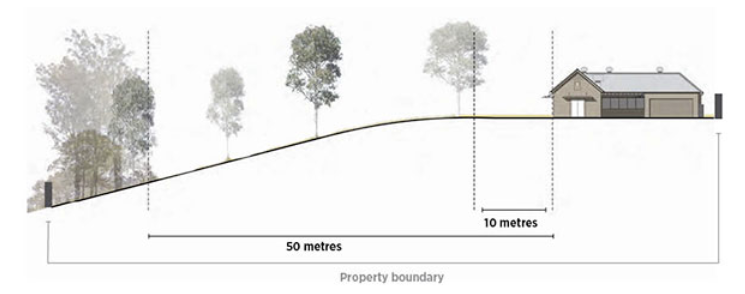
Reference: https://www.rfs.nsw.gov.au/plan-and-prepare/1050-vegetation-clearing
Vegetation Covered in the 10/50 Vegetation Clearing Rule
The 10/50 rule includes taking down trees and vegetation. You could be asking what exactly could be counted as ‘vegetation’? Don’t worry, many of our customers ask the same thing. We will cover it all below!
What’s technically considered a tree or vegetation?
Firstly, the 10/50 vegetation clearing defines trees as any permanent wooden plants located within the vicinity.
A tree should also have a single stem that reaches at least three metres in length with a chest-height circumference of above 30 centimetres.
Following the definition, we do not consider shrubs as trees under the rule. That said, any low-growing plants with small branches and vines are not included under the ten-metre rule, but any shrubs within a 50-metre radius are subject to removal.
The vegetation clearing rule only allows any facility to prune and cut down trees within a ten-metre radius. Nevertheless, when lopping and cutting a tree, it’s crucial to ensure a safe and efficient process.
For your tree pruning and removal, Trees Down Under streamlines a time-tested and reliable service to clear your establishment from unwanted vegetation. We will follow the regulations and policies indicated in the 10/50 legislation to ensure that we violate no environmental policies.
10/50 Rule: Other Points to Consider
When planning your building’s 10/50 vegetation clearing scheme, do not include the trees erected on slopes, regardless of the slope angle. That’s because the tree’s root system holds the soil together and prevents erosion.
If you don’t own the property (i.e., leasing or renting it), you’ll need the landowner’s approval and directives before you can implement the 10/50 vegetation clearing under the entitlement area rule.
Furthermore, the rule gives you a broad range of clearing methods you prefer, as long as you don’t use heavy equipment and procedures that alter the natural soil profile. That includes using graders and bulldozers or ploughing the leveled soil throughout the clearing operation.
Besides, clearing trees and foliage via burning is strictly prohibited. That’s why our arborists at Trees Down Under use safety gears and equipment to cut down any tree from top to bottom.
The rule also prohibits people from removing vegetation within a heritage site or about ten metres of a prescribed fire/peak streamflow. To determine whether there are prescribed streams or heritage areas near your site, feel free to use the official online tool from the NSW Rural Fire Service.
10/50 Vegetation Clearing Rule Restrictions
As discussed, any aboriginal land, slopes, or cultural heritage sites are restricted from the vegetation clearing rule.
Keep in mind that the rule applies only on properties within a 10 to 50-metre radius entitlement area, be it public or private property.
Who Can Implement the 10/50 Rule?
According to the legislation, only the landowner has directives and jurisdiction to clear vegetation within the specified radius.
For renters and tenants, you’ll need a written and legal direction from your landowner. Otherwise, any environmental violation won’t be covered under the ruling.
If you’re still unsure whether your property will fall under the 10/50 rule, feel free to reach out to our experts. We will be able to provide expertise, as well as provide any services required to help you safely and efficiently remove any unwanted trees in your property.
Common Tree Diseases in Australia: What You Need To Know
Tree disease is defined as any deviation in the normal functioning of the plant that is caused by a persistent agent. This agent may be any environmental factor, animals, insects, fungi, or basically anything that disrupts the normal functioning of the tree.
Here in Australia, trees are our greatest assets. When we talk about the beauty of nature in this country, we couldn’t miss mentioning the abundance of unique evergreen that we have. Our backyard, courtyard, and orchards have surely a tree that we’re proud of.
Nevertheless, when disease and other forms of tree infestation arise, we got a problem at hand.
The species of trees found in Australia are known for their resilience and toughness. However, they are not invincible and are prone to acquiring different kinds of diseases over their lifetime.
If you love your trees, you have to know how to take care of them. Here is some information about tree diseases we love to share with you.
Early Signs of Tree Diseases
It is best for you to know the early signs of tree diseases in order to promptly intervene. The earlier you can apply treatment to your tree, the better are the chances for recovery.
Here are the early signs of tree diseases you should watch for:
Reduced and Discoloured Foilage
The state of foliage and leaves are obvious indicators of the tree’s health. During the summer and spring, there should be full leaf coverage. Unusual changes in leaf appearance, decreased foliage, and discolouration is indicative of tree disease.
Tree Bark Changes
An unhealthy tree can be diagnosed by checking its bark. If you see cracks, unusual peeling, or changes in the consistency of the bark, then there’s something wrong with the tree. The presence of fungus and destructive insects are also an indication that your tree is sick.
What Causes Stress in Trees?
Stress is something common to all living things. Trees experience stress too. Trees are maybe just too sensitive, right?
What causes stress on trees? You’d be surprised to know that the stressors affecting trees are more common than you may have thought. Aside from the visual cues, there are important things to know about when your trees are under stress.
Here are situations that can cause stress on trees:
Installation Mismatch
There are situations where you could expose your young trees to stress right at the very start of installation. Planting the tree in wrong conditions like mismatched soil, improper depth, and location can be very stressful.
Trees that have been under stress for months or years will show several tell-tale signs such as stunted growth, discolouration of bark and leaves, and even sudden death.
Improper Pruning and Mulching
Regular tree maintenance activities like pruning and mulching can cause stress to your plants if done incorrectly. Improper techniques can lead to problems you’ll later see.
Pruning during the wrong season could be dangerous as you’ll be exposing the tree to insects and diseases. There are also rules to follow in terms of the type of tree and the size to be pruned.
Too much or too little mulch can also be harmful. Too much mulch can lead to rotting of the roots due to excessive moisture. Too little mulch, of course, would have little to no effect. Make sure you understand the principles of mulching before doing it yourself.
Poor Maintenance of Trees
Most trees can grow and live without needing any assistance. However, there may be some species that require attention and maintenance.
Top 10 Common Tree Diseases in Australia
The most common cause of tree diseases in Australia are fungi and insect infections. They are continuous threats that we need to understand and learn how to identify.
Here is the list of the most common tree diseases in Australia:
- Cypress Canker
This tree disease is a water-borne infection. This has plagued a lot of Cypress trees in Australia over the years. Cankers are caused by fungi and appear as deep red colour on branches causing them to die very quickly. Some reports say branches die within 24 hours.
Following the death of branches, spores are released by the fungi to affect other healthy branches. The cycle repeats until the whole tree dies and other nearby trees are affected as well. The good news is this disease is easily managed. Cutting the affected branch will prevent the spread to other parts of the tree.
- Myrtle Rust
First detected in 2010, this fungal infection causes bright yellow powdery spots on the leaves of the tree. The leaves will turn brown or grey before eventually dying. The spores are easily transmittable through the air and would require rigid fungicide treatment and quick isolation measures.
- Pink Disease
This tree disease affects a wide variety of trees in Australia. The fungal pathogen grows within the bark and makes it swell, split and kills the tree in a short time. This disease has caused a lot of headaches to farmers of citrus trees in NSW, Queensland and the Northern Territory.
When removing branches afflicted with Pink disease, it is best to burn them immediately to prevent the spreading of the spores to other plants.
- Citrus Gall Wasp
This bark infection is caused by the Gall Wasp. The insect lay its eggs in the branches of the tree then the infection starts. The presence of these eggs will cause the branches of the tree to bulge and swell. You have to act quickly by cutting the affected branches to prevent the cycle of infection from repeating and spreading across the whole tree.
- Root Rot
Root rot is the rapid decaying of a plant’s root system while it’s still alive. Signs of root rot include the appearance of small, discoloured, wilted leaves. The branches also show signs of decay. Root rot is difficult to diagnose and you may need the help of an arborist to help you in managing this tree disease.
You can avoid root rot by keeping the soil well-cultivated and ensuring there’s efficient drainage around the tree.
- Oak Wil
Oak wilt is caused by a soil-borne fungus that is spread by beetles. Signs of Oak Wilt include the appearance of wilted, rust coloured leaves that are present even if it is in season. This is a very fast-acting infection that can kill a tree within a single season.
However, managing this type of tree disease is fairly easy. You have to build a trench around the roots of the affected tree. Cut the roots to keep the infection from spreading to nearby trees. You should act fast though as infection of this type spread very fast.
- Peacock Spot
Commonly seen among olive trees across the world, this tree disease is caused by fungi leading to stunted growth, blemishes, and delayed fruit ripening. Sooty blotches appear on the leaves of the plant which then develop into black circular spots with a yellow halo.
Treatment of this tree disease involves spraying the foliage with copper compound.
- Tree Leaf Diseases (Teratospaeria)
This type of disease is common among gum trees but affects eucalyptus trees as well. A group of fungi infect the trees affecting the leaves. The infected leaves’ appearance depends on the type of fungus that caused the disease. You need to watch out for spots that are of a different colour (purple, red, brown, yellow) with black spores alongside them.
- Anthracnose
This fungal infection affects the growing leaves of trees. The pathogen eats through the leaves leading to holes and extreme defoliation. Damp and wet environments are factors that may lead to overgrowth and proliferation of the fungi.
Management and treatment of Anthracnose infection involve cutting the affected part and burning it to prevent the spread of infection.
- Emerald Ash Borers
These little beetles can cause severe destruction to your tree if left unattended. The bark of your trees is the primary target of these pests. They bore holes and create tunnels inside the tree.
If you notice discolouration in the leaves and dying branches of Ash trees during the spring, these creatures are surely present. Insecticides can be helpful to some extent but it is not totally reliable. Trees infected with Emerald Ash Borers should be removed.
Final Thoughts
The care of our beloved trees lies in our hands. We have to remember that we have an obligation to keep the trees in our properties healthy. Proper tree maintenance can be easy but you need adequate knowledge and skills to do that.
If you are unsure if your trees are healthy, under stress, or afflicted with disease, it is best to call on professional arborists to help you in assessing the condition of your plants. They can properly diagnose and recommend specific treatments for your sick trees.
Best Time of the Year to Trim Trees
As the popular belief says, there is perfect timing for everything. Believe it or not, that is also the case when trimming your trees. Although trees can naturally grow without too much human intervention, it’s a different issue when you need to maintain their well-being inside a property. Trimming and pruning are essential to achieve the right height and attain the preferred foliage volume for safety and aesthetic.
Most gardeners would suggest trimming and pruning during the trees’ dormant season. As an expert, we are saying that it is partly true. Besides dormancy, there are many other things to consider, such as desired landscape design, safety, and trees’ well-being.
Trim to Achieve Attractive Growth
In time, leaves will grow thick enough to look untidy for some garden owners. Specifically, if you consider your trees as lawn enhancers and as hedges, you need to maintain their foliage volume.
For instance, topiaries, which forms the foliage into ornamental shapes, require detailed clipping maintenance whenever they deform. Meanwhile, hedges need regular cutting to stay on their required height, width, and spacing.
So consider minor trimming efforts any time of the year to achieve attractive growth of trees. However, note that you should only cut up to 10-15% of the tree’s canopy to keep them healthy and strong.
Trim to Prevent Accidents
You cannot deny the fact that trees are a falling hazard. Their heavy branches and large trunks are enough to knock down a person. In fact, about 150 workers suffer from injuries while conducting tree works every year.
Furthermore, they are significantly dangerous when a storm is coming. Based on research, 150km/hr (Category 3 cyclone) is the critical wind speed where a tree trunk breaks regardless of size or species. If you don’t want to remove your trees, pruning them might be the next best option.
For safety, plant only small to medium-sized trees on your property. But if you want the large ones, ask professional arborists to conduct pruning services at least once every two or three years to maintain a safe height and distance.
Trim to Get Rid of Possible Pests and Diseases
Once pests and diseases have affected trees, you should cure them right away with different tree treatments.
Cutting down pest-infested and diseased branches are essential to extend the life of your sick tree. Also, it is a way to contain the spread of the disease in your outdoor space. However, spotting warning signs of illness is not as easy as it sounds. Thus, check out this article for guidance.
Don’t wait for these pests and diseases to spread uncontrollably. Trees Down Under is just one call away for your trimming and pruning needs, anytime or anywhere in Sydney.
Trim When Necessary
Once trees mature, they require less maintenance and care unless they have incurring pests or diseases. However, they need trimming and pruning from time to time to keep their groom and beauty.
You can set a schedule with experts to conduct intricate clipping of leaves and cutting of branches. As some people recommend, winter or early spring is the best time to perform these tasks to ensure healthy growth, especially for deciduous trees. However, some trees don’t follow this principle.
Thus, it is best to research intensely and connect with a garden service provider like Trees Down Under to prevent hasty decisions. In the end, it is for the safety and well-being of your trees.
Conclusion
Aside from plants and shrubs, trees are a perfect addition to your garden, especially if you want a breath of fresh air. And like any other living, they require proper care and treatment for healthy growth.
One way to do that is through trimming. It keeps trees’ foliage in shape and gets rid of pests and diseases. Honestly, you can cut leaves and branches any time of the year, especially when they become a threat to the community’s health and safety.
Most Trusted Tree Service Provider in Sydney
Most of the time, you need experts when clipping thick leaves and cutting heavy branches. Fortunately, Trees Down Under is your trusted partner for your tree care and treatment needs. Our team has expert arborists who provide quick and excellent services tailored to your needs.
No job is too big or small for us. We have the right tools and equipment to finish tree trimming, pruning, felling, and removal, safely. Since 2005, we are the leading tree service provider who Sydneysiders call whenever they have tree related problems.
Don’t worry about calling us in the middle of the night since we are available 24/7 for emergency tree removal services! Contact us at 0475 463 597 or send us a message via email.
5 Drought-Tolerant Trees
During your days in school, your teacher taught you about the essential needs of trees. So, it is common knowledge that in order to grow well, these trees require sunlight, water, nutrients, and the appropriate type of soil.
But only a few people are aware that some trees require less water than others. These so-called drought-tolerant trees are the perfect addition to your garden space if you have little time, but you want trees for privacy and added property value.
Moreover, this type of trees can survive arid and dry conditions, which means you don’t have to worry about consuming too much water during the hottest months.
So if you want to save water, money, and time, consider these five attractive trees that require the least water in your outdoor space:
- Northern Red Oak (Quercus rubra)
Due to its maroon-shade foliage during winter, Northern Red Oak is one of the most popular backyard trees that homeowners want outside their property. This fast-growing tree develops a sturdy trunk and rounded crown with age. It reaches from 18 to 23 metres tall and 13 to 15 metres wide ─ which can be a perfect height and width for hedge trees.
Caring for Red Oak is easier compared to other trees as it only needs regular moisture. It prefers full sun and can tolerate acidic, loamy, sandy, well-drained, or clay soil.
Furthermore, the best time to plant Northern Red Oak is during spring or fall to avoid the hot climate. It needs deep watering at least once a week. At the time it matures, it can already become drought-tolerant.
- Cootamundra Wattle (Acacia baileyana)
In Australia, Acacia is the country’s largest genus of flowering plants with about 1,000 species identified. Meaning, you have a variety of choices available for your garden space. And a classic tree that can magnificently grow in your lawn is the Cootamundra Wattle, which is native to NSW.
As a garden owner, you don’t want to keep a monotonous colour mood in your backyard. With its attractive yellow flowers, Cootamundra Wattle can enhance the overall ambience of your outdoor space.
Aside from being an evergreen, Cootamundra Wattle only needs a few requirements. It survives best in full sun and acidic, well-drained, or moist soil but can grow on other types as well. Furthermore, it can undoubtedly adapt to changing climate conditions and perform well with low amounts of water once established.
- Japanese Tree Lilac (Syringa reticulata)
Japanese Tree Lilac is a large shrub or small tree that can grow from 6 to 9 metres and 4.5 to 6 metres wide. It can be a single or multi-stemmed tree with clustering and musky-scented white flowers that bloom in early spring.
It can tolerate light shade but grows the best in full sun with medium moisture condition and well-drained soil. Moreover, it can adapt well to an urban environment but needs good air circulation.
Japanese Tree Lilac can survive most pest infestations and disease problems. It is resistant to mildew, bacterial blight, scale insects, and lilac borders. Meanwhile, it needs deep watering every 7-10 days as long as there is well-established drainage.
- Eastern Redcedar (Juniperus virginiana)
Eastern Redcedar is a sought-after tree in most lawns since it’s an excellent landscape enhancer. Its dense pyramid shape is perfect as windbreaks and screens. It can reach 12 to 15 metres in height and 2.4 to 6 metres in width. In late summer and fall, it produces blue berry-like fruits, which adds vibrance to your garden.
It prefers full sun and grows on almost all kinds of soil. Moreover, since its fruits attract birds, it can effortlessly propagate. Tree maintenance for Eastern Redcedar can be minimal since it is tolerant to drought, heat, salt, and wind once established.
- Jacaranda Tree (Jacaranda mimosifolia)
One thing is certain. Jacaranda tree is truly a head-turner due to its purple-blue, fragrant, and trumpet-shaped flowers that bloom enchantingly. Most garden owners consider it as an ornamental tree that is perfect when formed in a row. It can grow up to 15 metres tall and 9 metres wide.
It blooms best in full sun and well-drained soil. Also, it thrives nicely in warm conditions and tropical climate areas. Unfortunately, it does not go well with below zero temperature, and its first two winter years are crucial for its growth. Once it survives the first two years, frost is not a problem anymore. Lastly, it is drought-tolerant, but watering is required during the dry season.
Conclusion
Taking care of trees can be quite a hassle. Probably, with your busy schedule, you won’t have the time to water them, especially during the driest season. If that is the case, it is best to invest in trees that require less water than others. You cannot only save time but money and resources as well.
Hopefully, with the presented five drought-resistant trees, we have answered your questions. And if you choose to plant them, you can always ask our team at Trees Down Under!
Tree Service Provider in Sydney
Trees Down Under have skilled, licensed arborists who can make the job done with our various tree services in Sydney. From trivial tasks such as mulching to complicated ones such as tree removal, we have the gears and equipment to finish them safely and quickly.
We service residential, commercial, and industrial clients. We also offer 24/7 emergency tree removal services! Don’t hesitate to contact us at 0475 463 597 or send us a message.
Complete Guide to Pruning and Trimming Large Trees
Aside from flowering plants and greenery shrubs, most garden owners wish to have trees in their outdoors. Trees can add privacy, security, and value to one’s property. Also, tall and mature trees can provide shade and fresh air, particularly essential during the hottest months.
Just like how you take care of other plants, your trees require proper maintenance to keep them strong and healthy, especially during extreme weather conditions. Aside from nutrient-rich soil, water, sunlight, and fertilisers, they need proper trimming to avoid pest infestations and diseases.
However, the trimming process involves a lot of considerations. And since some trees even grow up to 60m tall, they can become a liability. Maintaining massive and lofty trees requires complicated trimming techniques and treatments.
So, are you wondering how to trim those really big trees? Here is Trees Down Under’s detailed guide:
Planning
Trimming is not only limited to reducing the thickness of the trees’ foliage, but it also involves removing unwanted, dead, and diseased branches. These tasks need a professional’s touch, and some even require necessary permits from the local council.
Moreover, working with massive branches and towering trees are dangerous. Without careful planning, dangers, such as falling branches, can damage your property or cost someone’s life. Thus, connecting to expert arborists is the best course of action to take.
Prepare Appropriate Tools
Using the appropriate tools is essential to prevent causing damages to your lawn trees. In fact, incompatible and defective apparatus can cause tree wounds that may soon invite pests and diseases into the trees’ systems. Furthermore, people who need to work with falling branches require personal protective equipment (PPE).
Here are some of the tools and PPEs used to trim leaves and branches:
- Pruning shears – to cut small twigs with a maximum diameter of 2.5cm.
- Lopper – has longer handle and sturdier blade to cut branches with a maximum diameter of 5cm.
- Pole pruner – extends up to 45m to reach and cut branches with a maximum diameter of 5cm.
- Saw – attached to pruners to cut branches with a much larger diameter.
- Ladder – to reach high trees.
- Helmet – to protect the head from falling objects.
- Gloves – to allow better grip on tools and avoid hand cuts.
- Eye gear – to prevent tree debris from entering the eyes.
Note that depending on how complicated the task is, you need to get help from professionals to avoid mishaps caused by these tools.
Clipping Leaves
Through time, leaves will grow thick, especially evergreens which never lose their foliage during the winter season. Bulky and packed leaves are unattractive for your garden. So if it happens, you need to consider clipping them right away.
Here are the things to consider and do in clipping those leaves:
- Depending on your preference, decide if the thickness of the foliage is right.
- Check for discoloured leaves and pests. If present, remove garden pests or cut the leaves when they fully turn yellow or brown.
- Cut as close to the stem as possible. Use the right shears depending on the required reach and diameter.
- Avoid cutting more than a quarter of the overall foliage.
- Trim trees during early spring since they can get more sunlight and are actively growing.
On the other hand, some garden owners want their trees to turn into a topiary, which forms the foliage to a desired geometrical shape. You can only achieve this with the professional techniques of tree service providers like Trees Down Under.
Trimming Large Tree Branches
Again, trimming large tree branches is a falling hazard. Depending on how large the project is, you need to hire professional arborists to finish the tasks without faults and accidents. Also, based on local council regulations, they are the only ones capable of conducting tree works.
Dealing with large branches needs extra care and effort. Once the bark gets damaged, it can interfere with the tree’s natural healing response. And as some experienced individuals would say, doing it right is more difficult than doing it wrong.
Here are some of the techniques arborists do to trim those unwanted, infested, or diseased branches, safely:
- Cut # 1: Notch Cut
From about 60-90cm of the trunk, cut a small notch approximately a quarter of the diameter. The notch cut will prevent the bark from splitting after making the next cut.
- Cut # 2: Relief Cut
About 30cm from the branch collar, make a relief cut all the way through. It will remove the weight and prevent the branch from splitting and falling during the final cut.
- Cut # 3: Final Cut
Locate the swollen bump that transitions the smooth branch bark and the branch collar. Then use a saw to follow the slant of the branch collar. If the tool cannot penetrate the crotch at the right angle, cut it from the bottom up.
Best Team of Arborists in Sydney
Maintaining the health and well-being of trees requires more effort than flowering plants and shrubs. As they grow taller and produce thicker foliage, trimming them is not as easy as it sounds.
Trimming really big trees need professional arborists. Luckily, Trees Down Under is available to bring the best tree services in Sydney. Our team of arborists will undoubtedly come to your aid wherever you are in Sydney.
For years, we have trained and studied to provide unrivalled and efficient tree services. Moreover, we have the right equipments and gears to prevent accidents.
For excellent, fast, and affordable tree services in Sydney, don’t hesitate to call us at 0475 463 597.


